
Free CRM vs Paid CRM: The Complete Buyer's Guide for Small Businesses in India
Why This Guide Matters
Every growing business reaches a point where managing customers becomes more difficult than generating them.
In the beginning, everything feels simple. Customer names are remembered by the owner, enquiries are noted in Excel, quotations are prepared manually, and follow-up reminders are written in notebooks or stored as phone reminders. With only a few enquiries every week, this informal approach seems sufficient.
Growth changes everything.
As businesses expand, enquiries start arriving from multiple channels simultaneously Google Ads, Meta campaigns, websites, WhatsApp, referrals, IndiaMART, exhibitions, telecalling campaigns, and direct phone calls. Customer information becomes scattered across spreadsheets, inboxes, WhatsApp chats, notebooks, and individual employee devices.
This fragmentation creates problems that are often invisible at first.
A quotation is delayed because the salesperson was busy.
An enquiry received on WhatsApp never reaches the sales team.
Two representatives unknowingly contact the same prospect.
A warm lead is forgotten after an exhibition.
An existing customer calls, but nobody remembers the previous conversation.
Most business owners believe these are isolated mistakes.
They are not.
They are symptoms of a sales process that has outgrown manual management.
Businesses continue investing in marketing to generate more enquiries, yet conversion rates remain flat because operational processes cannot keep pace with growth. More leads enter the business, but the same inefficiencies continue to leak revenue every day.
This is where Customer Relationship Management (CRM) software becomes essential.
A CRM is far more than a digital address book. It acts as the central operating system for your sales process, ensuring that every enquiry is captured, every interaction is recorded, every follow-up is scheduled, and every opportunity remains visible until it is either won or lost.
Choosing between a Free CRM and a Paid CRM is therefore not simply a pricing decision. It is a strategic decision that affects sales productivity, customer experience, operational efficiency, and long-term business growth.
This guide has been created specifically for Indian startups, MSMEs, manufacturers, distributors, service companies, consultants, and growing sales teams looking for practical guidance instead of marketing promises.
Rather than comparing features alone, we will answer the questions that business owners genuinely ask:
- Is a free CRM enough for my business?
- When should I upgrade to a paid CRM?
- Is Excel still a viable option?
- What hidden costs should I expect?
- How much return on investment can a CRM deliver?
- Which features become essential as my business grows?
By the end of this guide, you'll have a clear framework for selecting the right CRM based on your business stage, operational complexity, sales process, and growth plans.
Quick Answer
If you're looking for a simple answer, here it is.
A Free CRM is an excellent starting point for freelancers, startups, and small businesses that want to organize customer information, manage leads, and replace spreadsheets without increasing software costs.
However, as enquiry volumes increase, teams expand, and customer interactions spread across multiple communication channels, the limitations of free tools become more visible. Paid CRMs provide automation, reporting, integrations, collaboration, security, and scalability that help businesses maintain consistent sales execution.
The best CRM is not necessarily the one with the most features.
The best CRM is the one your team actually uses every day to build stronger customer relationships and generate predictable revenue.
Key Takeaways
Before exploring the details, here are the most important lessons from this guide:
- Free CRMs are ideal for businesses beginning their digital sales journey.
- Paid CRMs become valuable when operational complexity starts affecting revenue.
- The biggest cost is often not CRM software—it is missed follow-ups and lost opportunities.
- Most businesses outgrow spreadsheets long before they realize it.
- CRM success depends more on consistent sales discipline than software complexity.
- Automation should simplify repetitive work rather than replace effective sales processes.
- The right CRM should align with your business maturity instead of simply your company size.
Why Every Growing Business Needs a CRM
Every successful business starts with simple processes.
Customer details are stored in Excel.
Sales conversations happen over phone calls.
Follow-up reminders are written in notebooks.
Quotations are created manually.
For businesses receiving only a handful of enquiries every week, these methods often work surprisingly well.
The challenge begins when growth accelerates.
Imagine a manufacturing company receiving approximately 200 enquiries every month through Google Ads, Meta campaigns, WhatsApp, IndiaMART, dealer referrals, exhibitions, and inbound phone calls.
Initially, the owner knows every customer personally.
Within months, the situation changes.
Different salespeople maintain different customer lists.
Customer conversations become scattered across emails, WhatsApp, spreadsheets, and notebooks.
Managers spend hours requesting sales updates instead of reviewing meaningful reports.
Duplicate follow-ups confuse prospects.
Response times increase.
Conversion rates begin to decline.
The business is not losing sales because employees are working less.
It is losing sales because its operational systems have not evolved with its growth.
A CRM solves this challenge by creating a single source of truth for every customer interaction.
Instead of asking:
"Who last spoke to this customer?"
The answer is available instantly.
Instead of wondering:
"Has the quotation been sent?"
The complete customer timeline is visible.
Instead of depending on individual memory, businesses begin depending on standardized processes.
This shift—from memory-driven operations to system-driven execution—is one of the biggest milestones in building a scalable organization.
Why Spreadsheets Eventually Stop Working
Excel is one of the most useful business tools ever created.
It is excellent for calculations, reports, budgeting, and analysis.
It was never designed to manage active customer relationships.
As customer enquiries increase, spreadsheets begin creating operational problems.
Customer Information Becomes Fragmented
Information gets distributed across multiple locations.
- Phone calls remain on employee devices.
- Emails stay inside personal inboxes.
- WhatsApp conversations are disconnected.
- Meeting notes remain in notebooks.
- Customer history exists across multiple spreadsheet versions.
When employees leave, valuable customer knowledge often leaves with them.
Follow-Ups Depend on Human Memory
Many businesses still rely on salespeople remembering who needs to be called next.
As enquiry volumes increase, this becomes increasingly unreliable.
Without structured reminders:
- Customers wait longer.
- Opportunities lose momentum.
- Sales cycles become inconsistent.
- Revenue quietly leaks away.
Consistency not memory is what drives predictable sales performance.
Management Loses Visibility
Business owners regularly ask questions like:
- Which enquiries are still active
- Which quotations are pending
- Which salesperson owns this customer
- How many deals are expected to close this month
Without a CRM, answering these questions often requires collecting spreadsheets, making phone calls, and manually preparing reports.
With a CRM, these answers are available in real time through dashboards and pipeline reports.
A Practical Business Example
Consider a five-member industrial equipment distributor receiving approximately 250 enquiries every month.
Before implementing a CRM:
- Every salesperson maintained separate spreadsheets.
- Customer history was fragmented across multiple systems.
- Managers spent hours preparing sales reports.
- Follow-ups depended on memory.
- Weekly review meetings focused on finding information instead of discussing business growth.
After implementing a CRM:
- Every enquiry entered a centralized sales pipeline.
- Customer history became visible across departments.
- Follow-up reminders were automated.
- Managers monitored dashboards instead of spreadsheets.
- Weekly meetings shifted from administration to forecasting and revenue planning.
The products remained the same.
The marketing budget remained the same.
The sales team remained the same.
The difference was better sales execution.
For many businesses, improving execution generates greater returns than simply increasing advertising spend.
The Revenue Leakage Cycle
Generating more leads does not automatically increase revenue.
For many businesses, the real challenge begins after an enquiry is received.
A typical sales process often follows this pattern:
Lead Generated - Delayed Response - Missed Follow-up - Customer Loses Interest - Opportunity Lost - Increased Marketing Spend - More Leads - Same Operational Problems
This creates a cycle where businesses continuously invest in lead generation while the underlying sales process remains unchanged.
The result is predictable:
- Marketing teams celebrate lead volume.
- Sales teams struggle to manage growing workloads.
- Managers have limited visibility into pipeline health.
- Customers experience inconsistent follow-ups.
- Revenue leaks through operational inefficiencies rather than a lack of demand.
Breaking this cycle requires a structured system that captures every enquiry, assigns ownership immediately, records every interaction, schedules follow-ups, and provides complete pipeline visibility.
That is the real purpose of a CRM.
The CRM Maturity Model
Not every business needs the same CRM capabilities.
The right solution depends on the stage of business growth.
Stage 1 – Spreadsheet Operations
Typical Characteristics:
- Founder-led sales
- Limited monthly enquiries
- Manual quotations
- Personal follow-ups
- Excel-based tracking
Recommended Solution:
A simple Free CRM that replaces spreadsheets and centralizes customer information.
Stage 2 – Organized Sales
Characteristics:
- Dedicated sales representatives
- Multiple enquiry sources
- Standardized quotations
- Regular follow-up activities
Recommended Solution:
A Free CRM with lead management, reminders, pipeline tracking, and contact history.
Stage 3 – Growing Business
Characteristics:
- Multiple salespeople
- Marketing campaigns
- Field sales
- Telecalling teams
- Customer support
Recommended Solution:
A Paid CRM offering automation, integrations, reporting, role-based access, and workflow management.
Stage 4 – Business at Scale
Characteristics:
- Multiple branches
- Regional teams
- Manufacturing or distribution operations
- Advanced reporting
- Cross-functional collaboration
Recommended Solution:
An enterprise-ready CRM with automation, dashboards, API integrations, inventory or ERP connectivity, and advanced analytics.
What Is a Free CRM?
A Free CRM provides the essential tools needed to organize customer relationships without paying a subscription fee.
Most free solutions include:
- Contact Management
- Lead Tracking
- Basic Sales Pipeline
- Activity Timeline
- Task Reminders
- Notes
- Basic Reports
For startups and small businesses, these capabilities are often enough to replace spreadsheets and establish a structured sales process.
The goal of a Free CRM is not to provide every feature imaginable—it is to help businesses build sales discipline before introducing more advanced automation.
Is a Free CRM Enough?
For many businesses, the answer is yes—at least initially.
A Free CRM is generally sufficient if:
- You have a small sales team.
- Monthly enquiry volumes are manageable.
- Sales processes are relatively straightforward.
- Collaboration requirements are limited.
- You are replacing Excel for the first time.
However, growth changes the equation.
As the number of enquiries, employees, communication channels, and follow-up activities increases, businesses often require capabilities that extend beyond the scope of free software.
When Should You Upgrade to a Paid CRM?
There is no fixed number of employees or customers that determines when an upgrade is necessary.
Instead, watch for operational signals.
You should seriously consider upgrading when:
- Sales representatives spend excessive time on manual administrative work.
- Customer information is spread across multiple communication channels.
- Managers require real-time visibility into sales performance.
- Follow-ups become difficult to manage consistently.
- Marketing and sales teams need better coordination.
- Customer communication requires automation.
- Business reporting becomes increasingly manual.
- Security, permissions, and compliance become important.
A Paid CRM should solve business problems—not simply add more features.
Excel vs CRM
Many businesses ask whether Excel can continue serving as their customer management system.
The answer depends on business complexity.
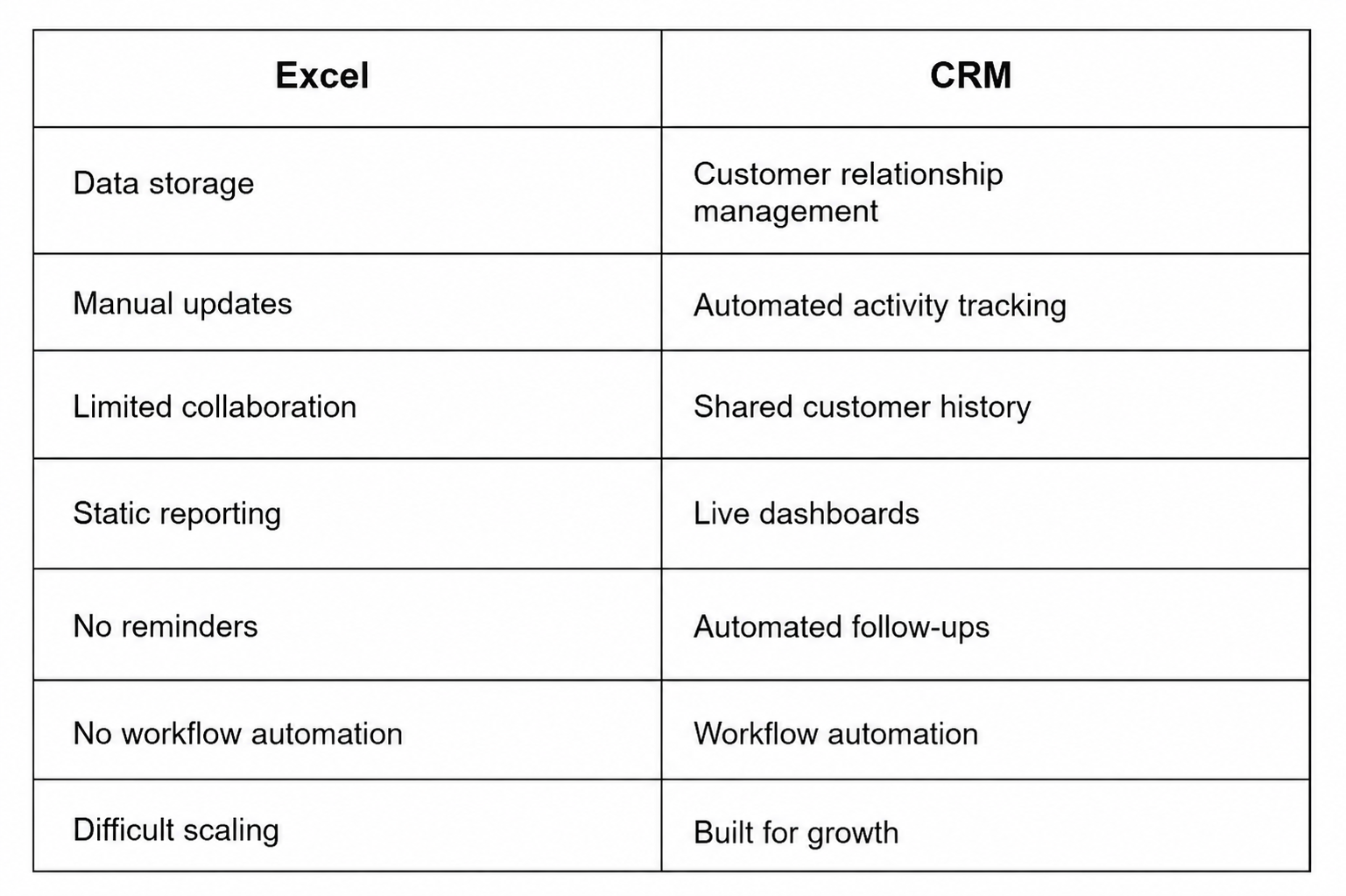
Excel remains an outstanding reporting tool.
A CRM becomes essential when customer relationships need active management rather than passive documentation.
The Cost of Doing Nothing
Many organizations postpone CRM implementation because they view it as an additional expense.
The greater cost often comes from continuing without one.
Without structured customer management:
- Enquiries receive delayed responses.
- Follow-ups are forgotten.
- Duplicate communication confuses customers.
- Managers lack visibility.
- Sales forecasting becomes unreliable.
- Customer knowledge remains dependent on individual employees.
These operational inefficiencies rarely appear on financial statements, yet they directly affect revenue growth.
Hidden Costs of Free CRM Software
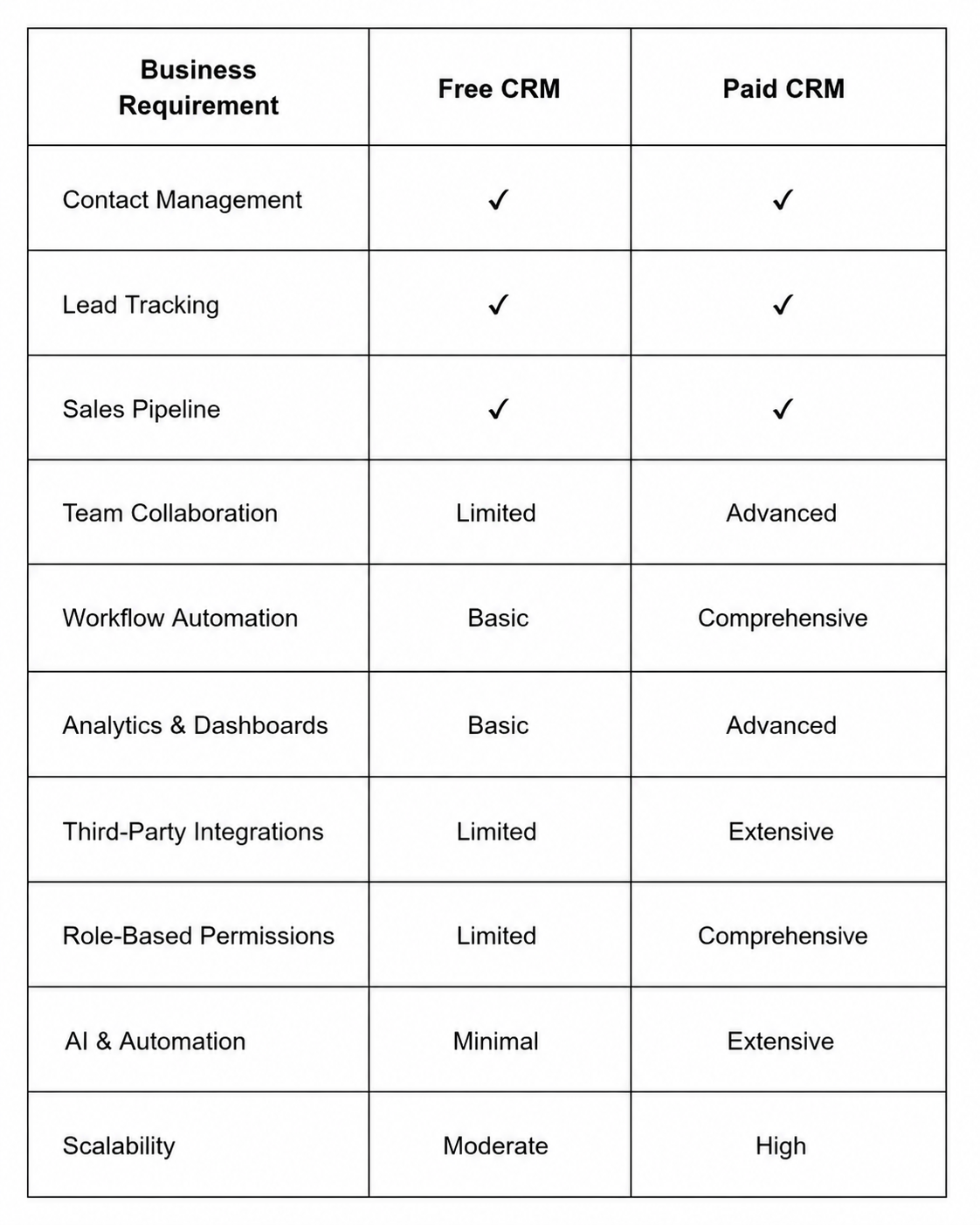
A Free CRM reduces software costs, but businesses should understand its practical limitations.
Common constraints include:
- Limited automation
- Restricted integrations
- User limitations
- Storage caps
- Basic reporting
- Limited customization
- Reduced customer support
These are not disadvantages for every organization.
For many startups, they are entirely acceptable.
The decision should be based on business requirements rather than feature comparisons alone.
Free CRM vs Paid CRM: Business Impact Comparison
How Much ROI Can a CRM Generate?
A CRM does not generate revenue by itself.
People and processes generate revenue.
A CRM enables them to operate more consistently.
Businesses often experience improvements through:
- Faster response times
- Better follow-up consistency
- Improved customer visibility
- Reduced administrative work
- Better forecasting
- Increased collaboration
- Higher sales productivity
The exact return depends on user adoption, process discipline, and implementation quality.
Common CRM Implementation Mistakes
Technology rarely causes CRM failure.
Implementation does.
Common mistakes include:
- Treating CRM as a reporting tool rather than a sales execution platform.
- Choosing software based only on feature lists.
- Failing to train users properly.
- Allowing inconsistent data entry.
- Automating inefficient processes.
- Ignoring user adoption.
- Delaying implementation until operational problems become severe.
Successful CRM adoption focuses on people, processes, and technology equally.
How to Choose the Right CRM
Before selecting any CRM, ask:
- How many enquiries do we receive every month?
- How many people manage customer relationships?
- Which communication channels do customers use?
- What reporting does management require?
- Which manual tasks consume the most time?
- Which business systems need integration?
- How will our business grow over the next three years?
Choosing software based on current needs while considering future growth helps avoid frequent platform changes.
Which CRM Fits Your Business?
There is no universally "best" CRM.
The best CRM is the one that matches your operational maturity, supports your sales process, and is consistently adopted by your team.
For businesses beginning their digital journey, a Free CRM often provides everything required to establish structured customer management.
As organizations grow, Paid CRM capabilities become valuable by reducing manual work, improving collaboration, enabling automation, and providing the visibility needed to scale.
The objective should never be owning the most sophisticated CRM.
The objective should be building a repeatable, measurable, and customer-focused sales process.
Final Verdict
For growing businesses, choosing between a Free CRM and a Paid CRM is not simply about software pricing—it is about selecting the right foundation for long-term sales execution.
A Free CRM is an excellent starting point for businesses that want to organize customer information, replace spreadsheets, and introduce consistent sales processes without increasing operational costs.
As the business grows, customer interactions become more complex, teams expand, and operational demands increase. At that stage, a Paid CRM provides the automation, collaboration, reporting, integrations, and scalability required to support sustainable growth.
Ultimately, the most successful CRM implementation is not determined by the number of features available.
It is determined by whether every enquiry is captured, every follow-up happens on time, every customer interaction is visible, and every member of the sales team works from the same reliable source of information.
A CRM should not simply help you manage customers.
It should help you build a business that scales with confidence, consistency, and measurable sales execution.
Frequently Asked Questions